


Overview of the new version EN 60079-10-1 for ATEX Zone Classification
In industries that store, produce or use flammable substances in the form of a gas or liquid capable of forming an explosive atmosphere, the classification of ATEX zones is the first step that Directive 1999/92/EC indicates as necessary to develop the “integrated safety” process, i.e. the beginning of any risk assessment.
Both the standard EN-60079-10-1: Site classification. Gaseous explosive atmospheres such as the UNE-EN 202007:2006 guide of the standard itself are the base documents used when making this classification of areas. Standards are regularly updated as technology and knowledge advances, and these changes can range from simple editorial modifications to major technical changes. The latest update of the ATEX zone classification standard EN-60079-10-1, from October 2016, introduces major technical changes that need to be addressed.
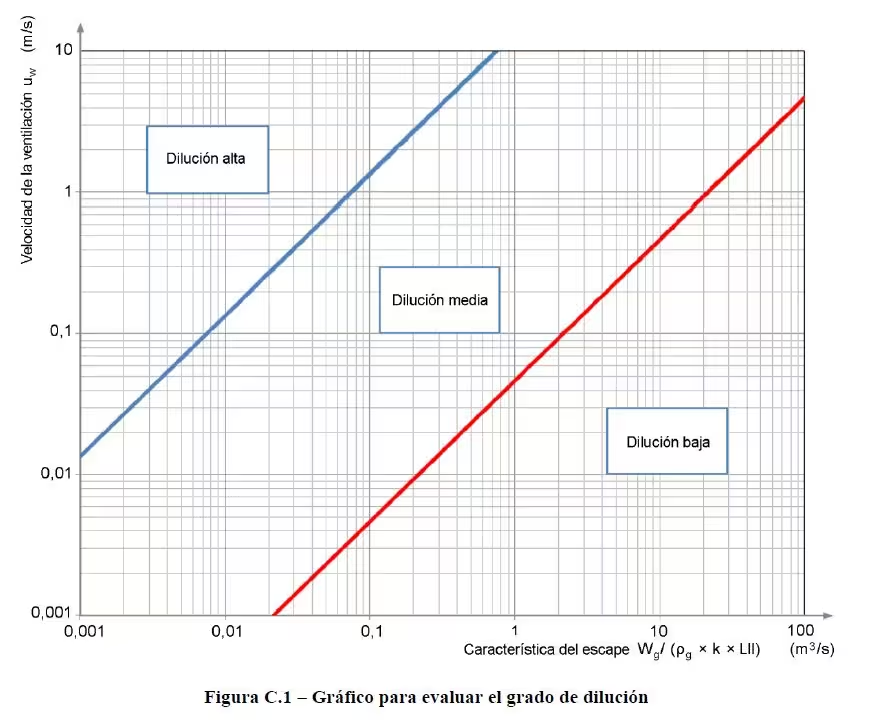
One of the main updates has to do with the concept of “hypothetical volume of explosive atmosphere, Vz”, used in the previous version of the standard to determine the degree of ventilation. In this update it disappears, using the concept of dilution depending on the characteristics of the exhaust and the speed of the ventilation air. The concept of “hypothetical volume” was related to theoretical studies, while the new concepts are related to CFD (Computational Fluids Dynamics) or computational analysis of fluid behavior.
Major technical changes have been introduced and, although it is not a harmonised standard, it is highly advisable to review the calculations made according to the previous standard, as we could find differences (e.g. in terms of the extension of areas obtained). At this point we can recall the need to periodically update the DPCE (Explosion Protection Document), indicated in Directive 1999/92/EC, and through which this classification of ATEX zones could be revised.
Below, we summarize some of the most relevant updates to the standard:
- Various ways of acting to make a classification of zones have been introduced, for example, using recognized international standards (such as API RP 505, NFPA 497), or using industry guidelines (such as IP15 or IGEM/SR/25). It is further indicated that the calculation method and/or a combination of methods may be used.
- The different types of exhaust (gas, liquefied gas, flammable liquid) and their behaviour in the face of a possible leak (what they call buoyancy, where the gas is directed when it leaks) have been much better defined. Technical changes have been made to the calculation of the exhaust rate:
- An example table has been updated and expanded to determine the exhaust hole more accurately.
- A discharge coefficient (Cd) has been introduced to account for the viscosity and shape of the exhaust hole.
- The initial concept of ventilation has been completely changed, including parameters such as gas dispersion and dilution in an environment.
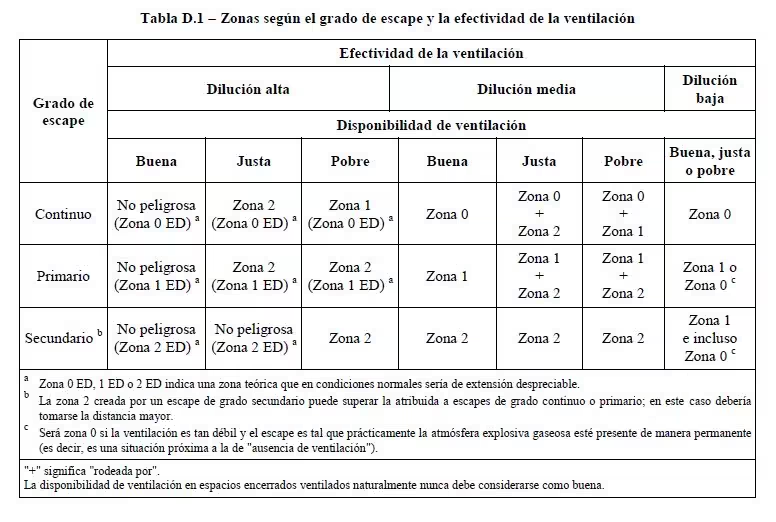
- The concept of “background concentration” is given much more importance when it comes to an enclosed area. In fact, it is the main parameter that indicates what type of zone will result.
- Information has been added on the shape of the exhaust (jet or diffusive type) and on the operation of ventilation in closed spaces, adding new formulas for calculating the ventilation flow (due to wind or temperature differences).
In addition, in the new version the extent of the classified areas is not calculated by formulas, but by the following graph:
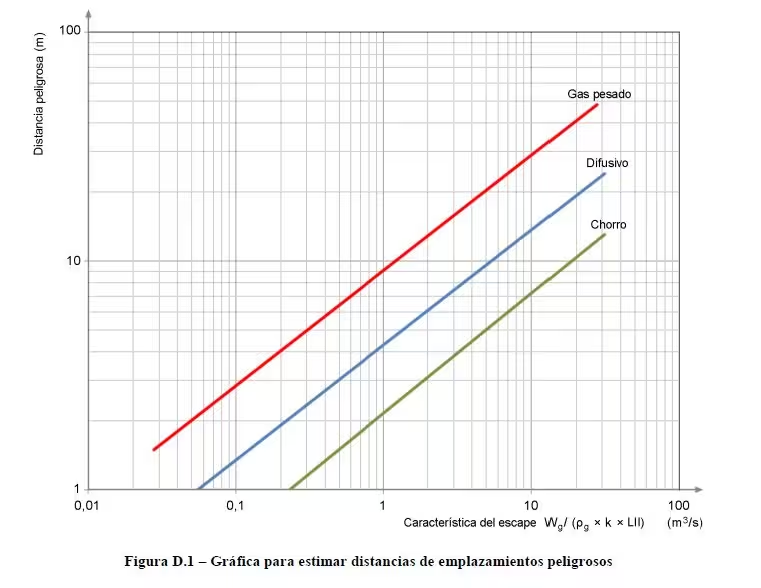
Recalculations often result in smaller ATEX zones than before, especially in outdoor areas. In closed spaces, although the distances are usually shorter as well, it depends a lot on the type of ventilation you have, whether natural or forced, and the arrangement of the ventilation grilles, etc., and it is recommended to classify the entire interior of the closed area if the resulting distances are significant.
In this update we can also find new examples of zone classification, as well as specific annexes for flammable fogs, hydrogen and international standards to take into account when classifying zones.
For more information, do not hesitate to consult our Engineering and Consulting service.
