


Explosion Risk Assessment in Bucket Elevators
|
Date:
|
|
Reading time: 6 minutos
(YOU CAN DOWNLOAD THE E-BOOK VERSION BY CLICKING HERE)
Bucket elevators, used for the industrial transport of solids, require a detailed explosion risk assessment
1. Introduction and regulations
Bucket elevators are one of the main equipment used for the transport of bulk solids in numerous facilities in the food industry in general: grain handling, breweries, feed mills, among others.
This equipment is one of the main areas of risk of explosion in industries where flammable dust is handled, mainly due to its great propensity to the generation of ignition sources of different origins. Hence, it is really important to carry out a correct explosion risk assessment in facilities that use this type of equipment, with the aim of reducing the probability of an explosion and, if it occurs, that its consequences are minimal, avoiding material and human damage.
There are several standards used internationally to carry out a correct risk assessment, among the most prominent are:
- The European Technical Report CEN/TR-16829: Fire and explosion prevention and protection for bucket elevators, deals exclusively with the prevention and protection of bucket elevators, based on several studies carried out.
- The German standard VDI-2263, part 8: Dust fires and dust explosions, Hazards-assessment-protective measures, Fire and explosion protection in elevators, 2008, is intended to be a guide for the prevention and protection of bucket elevators according to European directives 2014/34/EU and 1999/92/EC taking into account both the manufacturer and the end user.
- The American standard NFPA 61: Standard for the Prevention of Fires and Dust Explosions in Agricultural and Food Processing Facilities, has a section that speaks exclusively of prevention and protection measures in bucket elevators.

2. Explosion risk assessment
A correct assessment of explosion risks should include at least the following points:
- Classification of areas with risk of explosion.
- Evaluation of effective ignition sources.
- Probability of an explosion.
- Consequences of an explosion in equipment and facilities.
2.1. Classification of explosion risk areas in bucket elevators
It is common to consider the equipment as an indoor Zone 20 due to its high operating speed and high probability of continuously generating dust clouds in flammable concentration, but also due to the possibility of layers of dust adhering to the walls that can be suspended.
2.2. Effective ignition sources
1. Ignition sources produced by the elevator itself, such as the following:
- Hot surfaces, due to friction:
- of the band with the housing due to misalignment of the belt.
- of the belt with the pulley due to slippage if the belt tension is insufficient.
- of loose parts (buckets, pulley parts) with moving parts.
- Bearing failures, as bearings are in dusty ambient conditions and, in many cases, high temperatures, these conditions do not favour a long bearing life, so if a faulty bearing continues to operate with difficulty, heat will be generated.

- Mechanical sparks, due to:
- On impact of the buckets with the casing (due to insufficient belt tension, defective belt, falling buckets) or with the elevator outlet.
- Band misalignment.
- Electrical equipment, due to:
- Equipment without the correct protection or damaged.
- Incorrect grounding or lack of continuity.
- Electrostatic discharge, due to:
- Separation processes between belt and pulley.
- Electric charge of buckets due to induction.
- Loading of any other component without proper grounding.
2. Ignition sources introduced from other interconnected equipment, e.g. hot particles or explosions in other equipment as well as ignition sources produced by electrical equipment located outside the elevator.
3. External ignition sources due to maintenance, welding, cutting (hot work), smoking in the installation or deflagrations from other equipment. These types of ignition sources are prevented by organizational measures.
4. Ignition sources produced by the product to be conveyed, for example due to the self-combustion of dust accumulations inside the elevator.
3. Recommended prevention and protection measures
Taking into account the possible presence of explosive atmospheres on a near-continuous basis and the variety of ignition sources that can be effective, the probability of an explosion occurring in an elevator is high and its consequences can be catastrophic for facilities and people.
For this reason, both prevention and explosion protection measures are considered necessary in this equipment. Among them, the following should be considered.
3.1. Prevention measures
Measures to prevent explosions from occurring include:
- Prevention of explosive atmospheres:
- Dust collection systems on the foot and head of the equipment.
- Regular cleaning of the equipment.
- Preventing Ignition Sources:
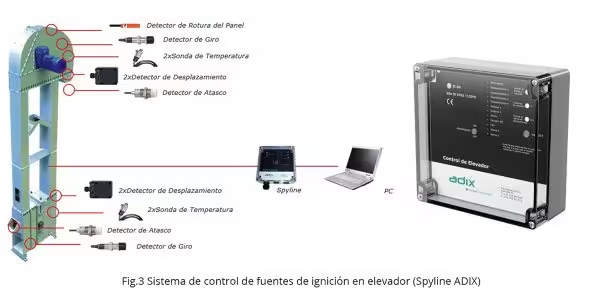
- Installation of magnets or grids to prevent the entry of foreign bodies.
- Belt deviation detectors.
- Rotation control on the motor axis of the foot.
- Jam detector at the point of product unloading.
- Temperature detection in bearings.
- Correct grounding and equipotentiality, use of an antistatic material band when the Minimum Energy of Ignition of the product is low (EMI < 10 mJ).
3.2. Protective measures
- Explosion vents installed on the foot, head and rods of the equipment, following the configuration indicated in recognized standards or guides (e.g. CEN/TR 16829).
- Flameless venting devices, in case the equipment is inside the facilities.
- Chemical suppression of the explosion by means of a flame extinguishing agent.

- Explosion, chemical or mechanical insulation:
- Mechanical isolation by means of certified rotary valves (according to ATEX Directive 2014/34/EU or NFPA 61) installed at the product inlet and outlet.
- Chemical isolation system (chemical barriers), installed at the inlet and outlet of the product.
- Mechanical insulation by means of a flap valve (passive insulation) installed in the dust suction pipe.

Note: The implementation of protection systems in bucket elevators must follow the indications of a recognized standard or guide (e.g. the aforementioned technical report CEN/TR 16829, VDI 2263 or NFPA 61).
