


Explosion Risk Assessment in Dust Collectors (Baghouses)
|
Date:
|
|
Reading time: 5 minutos
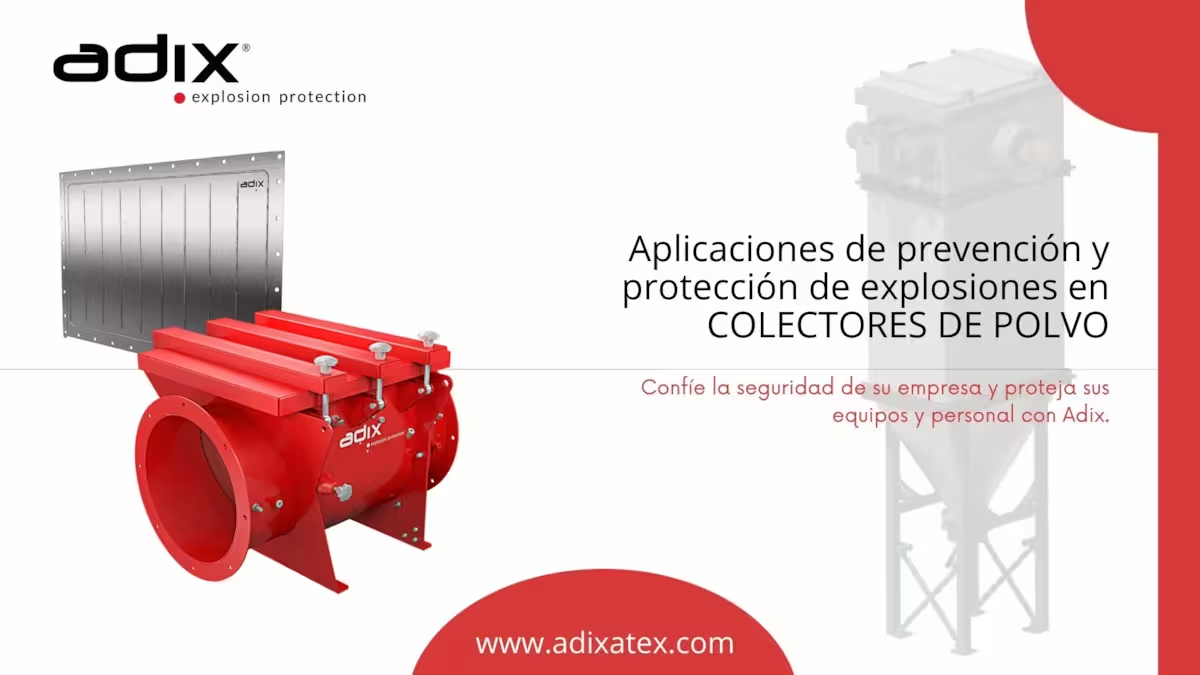
Dust collectors are one of the critical areas for explosion hazards in facilities that handle flammable dusts
Vacuum systems represent one of the main existing installations in industries that handle powdery substances, mainly aimed at controlling environmental dust emissions, thus reducing their pollution. Baghouses are the main component of a dust extraction system and in solid-gas separation systems, and they pose one of the main explosion hazards in industries where flammable dust is handled.
Carrying out a correct risk assessment in suction systems, and specifically in bag filters, must be one of the main objectives to establish an effective strategy against the risk of explosion in our facilities.
To carry out a correct assessment of the risk of explosion in these equipment, we can use as support some of the most widely used international standards of recognized prestige, among which we can highlight the following:
- The German standard VDI-2263, part 6: “Dust fires and dust explosions, Hazards-assessment-protective measures – Dust fires and explosion protection in dust extracting installations”, 2017.
- The guide to Directive 2014/34/EU, in the section dedicated to particular cases and more specifically in the section “§ 243 Filter units and vented silo bins”.
- The American standards NFPA 61: Standard for the Prevention of Fires and Dust Explosions in Agricultural and Food Processing Facilities, and NFPA 654: Standard for the Prevention of Fires and Dust Explosions from the manufacturing, processing and handling of combustible particulate solids.
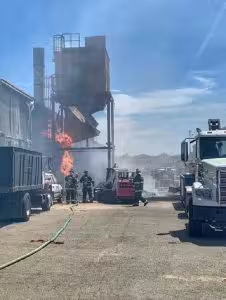
2. Explosion risk assessment
A correct assessment of explosion risks should include at least the following points:
- Classification of areas with risk of explosion.
- Evaluation of effective ignition sources.
- Probability of an explosion.
- Consequences of an explosion in equipment and facilities.
2.1. Classification of explosion risk areas in Dust collectors (bag filters)

Notes:
- Due to cleaning cycles or the possibility of accumulation of dust layers inside the filter (including dust layers on the bags). CME: minimum explosive concentration (g/m3). Examples: Sugar (30 g/m3); Starch (60 g/m3); Wood (30 g/m3). Data obtained through the GESTIS-DUST EX database: https://staubex.ifa.dguv.de/explosuche.aspx?lang=e
- An automatic cleaning system is considered to be any system that is carried out by means of pressurised air, either by means of a timer or by means of a differential pressure system, or any that is carried out by vibration or mechanically or requires activation through an external button. Manual cleaning involves stopping and opening the equipment, as well as disassembling and cleaning the filter media.
2.2. Effective ignition sources
- Mechanical sparks from other equipment, when the bag filter sucks from mechanical equipment susceptible to failure (mills, elevators, conveyors, etc.).
- Hot surfaces, due to friction in mechanical filter discharge equipment (rotary valve, worm screw) or in wood processing process equipment (saws, dryers, etc.).
- Electrical equipment, due to:
- Equipment without the correct protection or damaged.
- Incorrect grounding or lack of continuity.
- Electrostatic discharges, due to the accumulation of static energy due to the friction of the sucked product with the internal elements of the filter and the lack of equipotential continuity.
- Ignition sources introduced from other interconnected equipment, e.g., hot particles, fires, or explosions into other equipment.
- External ignition sources due to maintenance, welding, cutting (hot work), smoking in the installation. These types of ignition sources are prevented by organizational measures.
- Ignition sources produced by the product to be transported, e.g. due to the self-combustion of dust accumulations inside the filter.

3. Recommended prevention and protection measures
Considering the possible presence of explosive atmospheres on a near-continuous basis and the variety of ignition sources that can be effective, the probability of an explosion occurring in a bag filter is high and its consequences can be catastrophic for facilities and people.

3.1. Prevention measures
- Prevention of explosive atmospheres:
- Reduce cleaning cycles.
- Regular cleaning.
- Preventing Ignition Sources:
- Installation of a spark detection and extinguishing system in the suction pipeline to prevent the entry of sparks or hot particles from other equipment (see Figure 4).
- Installation of a fire detection system using CO detection, infrared or temperature detection.
- Correct grounding and equipotentiality of the sleeve supports, sleeves made of antistatic material.

3.2. Protective measures
- Explosion vents certified according to the ATEX Directive 2014/34/EU, with venting area calculated according to a recognized standard (EN 14491:2012, ‘Dust explosion venting protective systems’ or NFPA 68: “Standard on explosion protection by deflagration venting”).
- Flameless venting, in case the equipment is inside the facilities.
- Chemical suppression of the explosion, by means of a system certified according to the ATEX Directive 2014/34/EU.
- Explosion Isolation:
- Mechanical insulation by means of a flap valve (certified as a protection system according to the ATEX Directive 2014/34/EU or approved by an authorised body according to NFPA 69 standard) installed in the dust suction pipe.
- Chemical insulation system (chemical barriers), installed in the dust suction pipe.
- Rotary valves certified as isolation system (according to ATEX Directive 2014/34/EU or NFPA 69) installed at the product discharge.

