


Explosions in baghouses and dust collectors: causes and how to prevent them
|
Date:
|
|
Reading Time: 7 minutos

In industrial facilities where bulk solids are handled, dust collectors are critical equipment to ensure safety and operational efficiency. However, they also represent one of the points with the highest risk of explosion within the process.
This is because they concentrate large amounts of fine dust in suspension in a confined environment, where the presence of oxygen is constant. Under these conditions, the entry of an ignition source can trigger an explosion in a matter of milliseconds.
Understanding why this happens and how to prevent it is key to effective risk management in industrial plants.
What is a bag filter and how does it work?
A bag filter is a system designed to capture solid particles present in air streams generated during industrial processes such as milling, pneumatic conveying or material handling.
Its operation is based on a simple principle:
- Dust-laden air enters the collector.
- It passes through filter bags.
- Particles are retained on the surface of the bags
- Clean air is evacuated.
- The accumulated dust is released and collected in a hopper.
Main elements of the system
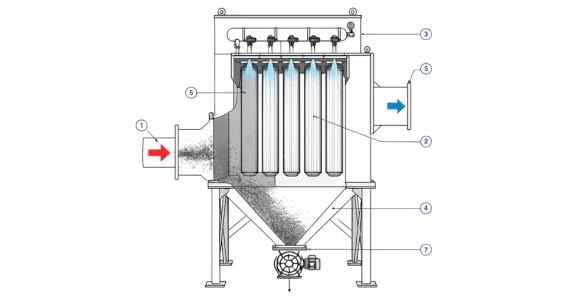
- Dirty air intake: dust-laden air enters the collector
- Filter bags: filter elements that retain dust particles
- Cleaning system (pulse jet): valves that release pulses of compressed air to clean the bags
- Collection hopper: area where dust accumulates separated from the bags
- Dirty air chamber: area where the air slows down and dust separation begins
- Clean Air Outlet – Outlet where clean air is expelled from the collector
- Discharge system: rotary valve or similar that allows the discharge of accumulated dust
For a better reference of the parts of a dust collector, we present the following image:
Although their function is to improve the cleanliness of the process, these equipment concentrate fine combustible dust in suspension, which makes them a critical point from a safety point of view.
Why do bag filters present a high risk of explosion?
Dust collectors meet multiple conditions that promote explosiveness:
- High concentration of combustible dust.
- Continuously or very frequently airborne dust
- Internal surfaces with material accumulation.
- Permanent presence of oxygen.
- Possibility of ignition sources (e.g. hot particles, mechanical sparks, static electricity)
Critical situations
There are times when the risk increases significantly:
- Bag cleaning (pulse jet): generates dense clouds of dust.
- Discharge of the material into the hopper: generates suspended particles.
- Generation of ignition sources: from the process.
These conditions can cause an explosion inside the equipment.
Most common ignition sources in dust collectors
An explosion does not occur without an ignition source. In dust collectors, these are usually associated with the process operation itself and/or human actions:
Incandescent particles
- Sparks from welding or cutting.
- Hot particles generated in previous processes.
Mechanical failures
- Friction between components.
- Impact of metal particles.
- Bearing failures. (fan and/or rotary)
Static electricity
- Accumulation of electrostatic charges
- Lack of grounding or equipotentiality
Electrical faults
- Non-certified equipment
- Overheating
- Short Circuits
What happens when a bag filter explosion occurs?
A dust explosion develops extremely quickly, when the right conditions are given, the sequence of an explosion is rapid and violent:
- An ignition source enters or is generated within the system
- The cloud of suspended dust ignites
- Combustion spreads at high speed
- A sudden increase in pressure occurs
Impact on installation
- Structural damage to the manifold
- Ejection of parts and material
- Propagation to Ducts and Connected Equipment
- Possible secondary explosions in other areas
These types of events make it clear that an explosion in a dust collector is not an isolated incident, but a phenomenon that can quickly escalate and compromise the entire facility. The speed with which it is developed, added to its ability to spread to other equipment and generate secondary explosions, makes these systems critical points within the plant.
Therefore, rather than reacting to damage, it is essential to anticipate risk through appropriate design, control of ignition sources and the implementation of protective measures that limit both the occurrence and impact of a possible explosion.
How to protect dust collectors from explosions?
The security strategy must be based on three fundamental pillars:
Prevention
Act on the causes of the risk:
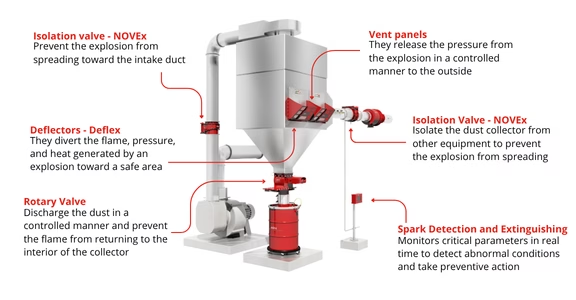
- Spark Detection Systems
- Industrial Cleaning
- Ignition source control
- Preventive maintenance programs
Protection
Reduce the effects of an explosion:
Explosion Isolation
Prevents spread to other equipment:
- Isolation valves
- Chemical barriers
Addressing the risk of explosion in dust collectors requires understanding that no single measure is sufficient. Prevention reduces the likelihood of an ignition occurring, protection limits the consequences if the event develops, and isolation prevents its effects from spreading to other equipment or areas of the plant.
True effectiveness lies in integrating these three stages into a single action plan, designed according to the specific conditions of the process. Only in this way is it possible to move from a reactive strategy to a comprehensive approach that controls risk from its origin to its possible consequences.
The importance of analysing the risk of explosion in each facility
The risk of explosion in industrial systems handling combustible dust is not uniform and cannot be assessed generically. Each installation has particular conditions that directly influence the probability of ignition and the severity of a possible explosion.
Key variables
- Nature of Dust
- Particle size
- Concentration in the air
- Process conditions
- Equipment Location
Each of these factors has a direct impact on critical parameters such as the ease of ignition, the speed of flame propagation and the pressure generated during an explosion. For example, finer and drier powders tend to be more reactive, while certain equipment configurations may favor the accumulation or dispersion of the material.
In addition, operational aspects such as changes in production, variations in raw materials or modifications in equipment can significantly alter the initial design conditions, generating risk scenarios that were not contemplated.
Therefore, it is essential to evaluate each installation individually, considering both the design and the actual operation of the process. This analysis makes it possible to identify critical points, validate the classification of areas and define truly effective prevention, protection and isolation measures.
In this context, having the support of specialists is key to transforming analysis into concrete solutions. At Adix Ingeniería, we focus precisely on this type of challenge, supporting the industry through explosion risk analysis, engineering development for protection systems and the adaptation of facilities to regulations such as ATEX.
This comprehensive approach allows not only to comply with regulatory requirements, but also to implement technical solutions aligned to the real conditions of each process, significantly raising the level of safety and operational reliability.
Conclusion
Baghouses and dust collectors are essential for emissions control in industry, but they also represent one of the most critical points from a safety point of view when handling combustible dusts. Its operation involves the constant concentration of fine material in suspension, which, under certain conditions, can lead to highly explosive scenarios.
The risk of explosion does not depend solely on the equipment itself, but on how it is operated, maintained, and integrated into the entire process. Factors such as the presence of ignition sources, operating conditions, the condition of the components and the interconnection with other equipment play a determining role in the real risk level of the installation.
Therefore, implementing adequate prevention, protection, and isolation measures should not be understood as independent actions, but as part of a comprehensive security strategy. A rigorous technical analysis allows us to identify specific vulnerabilities, define solutions adapted to each process and ensure that all layers of protection work in a coordinated manner.
Only under this approach is it possible not only to minimize the probability of an explosion, but also to limit its consequences and guarantee a truly safe, reliable operation aligned with applicable regulatory standards.
