



Baghouse and Dust Collector Explosions: Causes and How to Prevent Them
|
Date:
|
|
Reading Time: 6 minutos

In industrial facilities that handle bulk solids, dust collectors are essential equipment for ensuring safety and operational efficiency. However, they also represent one of the points with the highest explosion risk in the process.
This is because they concentrate large amounts of fine suspended dust in an enclosed space where oxygen is always present. Under these conditions, an ignition source can trigger an explosion within milliseconds.
Understanding why this happens and how to prevent it is key to managing the risk effectively in industrial plants.
What is a baghouse and how does it work?
A baghouse (bag filter dust collector) is a system designed to capture solid particles in airstreams generated by industrial processes such as grinding, pneumatic conveying or material handling.
It works on a simple principle:
- Air laden with dust enters the collector.
- It passes through filter bags.
- Particles are retained on the surface of the bags
- The clean air is exhausted.
- The accumulated dust is released and collected in a hopper.
Main system components
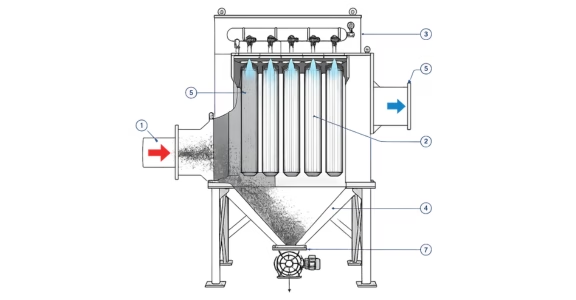
- Dirty air inlet: dust-laden air enters the collector
- Filter bags: filter elements that retain the dust particles
- Cleaning system (pulse jet): valves that release pulses of compressed air to clean the bags
- Collection hopper: where the dust released from the bags collects
- Dirty air plenum: where the air slows down and dust separation begins
- Clean air outlet: where the clean air leaves the collector
- Discharge system: rotary valve or similar device that discharges the accumulated dust
The following image shows the parts of a dust collector for reference:
Although their purpose is to keep the process clean, these units concentrate fine combustible dust in suspension, which makes them a critical point from a safety standpoint.
Why do baghouses pose a high explosion risk?
Dust collectors combine multiple conditions that favor explosions:
- High concentration of combustible dust.
- Dust in suspension continuously or very frequently
- Internal surfaces with material buildup.
- Constant presence of oxygen.
- Possible presence of ignition sources (e.g., hot particles, mechanical sparks, static electricity)
Critical situations
There are times when the risk increases significantly:
- Bag cleaning (pulse jet): creates dense dust clouds.
- Discharging material into the hopper: puts particles into suspension.
- Ignition sources generated by the process.
These conditions can cause an explosion inside the equipment.
Most common ignition sources in dust collectors
An explosion cannot occur without an ignition source. In dust collectors, ignition sources are usually linked to process operation and/or human activity:
Glowing particles
- Sparks from welding or cutting.
- Hot particles generated in upstream processes.
Mechanical failures
- Friction between components.
- Impact of metal particles.
- Bearing failures (fan and/or rotary valves).
Static electricity
- Electrostatic charge buildup
- Lack of grounding or bonding
Electrical failures
- Non-certified equipment
- Overheating
- Short circuits
What happens when a baghouse explodes?
A dust explosion develops extremely fast. When the conditions are right, the explosion sequence is quick and violent:
- An ignition source enters or is generated inside the system
- The suspended dust cloud ignites
- The combustion propagates at high speed
- Pressure rises suddenly
Impact on the facility
- Structural damage to the collector
- Ejection of parts and material
- Propagation to connected ducts and equipment
- Possible secondary explosions in other areas
These events make it clear that a dust collector explosion is not an isolated incident but a phenomenon that can escalate quickly and compromise the entire facility. The speed at which it develops, together with its ability to spread to other equipment and cause secondary explosions, makes these systems critical points in the plant.
Rather than reacting to damage, it is essential to anticipate the risk through proper design, ignition source control and protection measures that limit both the likelihood and the impact of an explosion.
How do you protect dust collectors against explosions?
The safety strategy should rest on three pillars:
Prevention
Addresses the causes of the risk:
- Spark detection systems
- Industrial housekeeping
- Ignition source control
- Preventive maintenance programs
Protection
Reduces the effects of an explosion:
- Explosion venting and flameless venting (for indoor locations)
- Suppression systems
Explosion isolation
Prevents propagation to other equipment:
- Explosion isolation valves
- Chemical barriers
Addressing explosion risk in dust collectors means understanding that no single measure is enough. Prevention reduces the likelihood of ignition, protection limits the consequences if an event develops, and isolation keeps its effects from spreading to other equipment or areas of the plant.
Real effectiveness comes from integrating these three layers into a single action plan designed around the specific process conditions. Only then can you move from a reactive strategy to a comprehensive approach that controls the risk from its source to its potential consequences.

Why each facility’s explosion risk must be analyzed
Explosion risk in industrial systems that handle combustible dust is not uniform and cannot be assessed generically. Each facility has specific conditions that directly affect the likelihood of ignition and the severity of a potential explosion.
Key variables
- Type of dust
- Particle size
- Concentration in air
- Process conditions
- Equipment location
Each of these factors directly affects critical parameters such as ease of ignition, flame propagation speed and the pressure generated during an explosion. For example, finer and drier dusts tend to be more reactive, while certain equipment configurations can promote material buildup or dispersion.
Operational factors such as production changes, variations in raw materials or equipment modifications can also significantly alter the original design conditions, creating risk scenarios that were not considered.
That is why each facility must be assessed individually, considering both the design and the actual operation of the process. This analysis makes it possible to identify critical points, validate the hazardous area classification and define truly effective prevention, protection and isolation measures.
Working with specialists is key to turning that analysis into concrete solutions. At Adix Ingeniería, we focus on exactly these challenges, supporting industry with explosion risk analysis, engineering for protection systems and bringing facilities into compliance with standards such as ATEX.
This comprehensive approach not only meets regulatory requirements but also delivers technical solutions aligned with the real conditions of each process, significantly raising safety and operational reliability.
Conclusion
Baghouses and dust collectors are essential for emission control in industry, but they are also one of the most critical points from a safety standpoint when handling combustible dusts. Their operation involves a constant concentration of fine suspended material, which under certain conditions can lead to highly explosive scenarios.
Explosion risk depends not only on the equipment itself but on how it is operated, maintained and integrated into the overall process. Factors such as ignition sources, operating conditions, component condition and interconnection with other equipment play a decisive role in the facility’s real level of risk.
Prevention, protection and isolation measures should therefore not be seen as separate actions but as part of a comprehensive safety strategy. A rigorous technical analysis identifies specific vulnerabilities, defines solutions tailored to each process and ensures all layers of protection work together.
Only with this approach is it possible to minimize the likelihood of an explosion, limit its consequences and ensure truly safe, reliable operation in line with the applicable standards.
