



Have a challenging application?
Talk to our engineering team
Send us the process information together with the relevant safety requirements and project criteria. We will review the application with you and discuss the available options.
From safety requirements to practical explosion prevention and protection solutions
ADIX provides specialized engineering support to explosion safety consultants, process safety and EHS engineers, project engineers, maintenance and plant engineering teams, EPCs, OEMs and other professionals responsible for industrial safety and project implementation.
When a combustible dust hazard has been identified and prevention or protection measures are required, we help translate the project’s safety requirements and recommendations into practical, technically justified and implementable solutions.
We work as a specialized technical resource within the project team, complementing the expertise of the professionals responsible for safety, engineering, operation and maintenance of the facility.


Specialized knowledge when your project requires it
Combustible dust projects often involve safety, process, project, maintenance and equipment specialists. Each brings a different perspective, while the explosion prevention and protection measures themselves require highly specialized application knowledge.
ADIX supports these teams in developing and implementing the required measures, from the initial protection concept through detailed engineering and installation support. We regularly work alongside:
NFPA, ATEX / EN, IECEx and FM project requirements
The prevention and protection concept must be developed around the characteristics of the process, the combustible material, the equipment being protected, the intended use of the protection system and the regulatory framework applicable to the project.
Depending on the location and requirements of the project, ADIX can develop its engineering in accordance with applicable NFPA standards, ATEX requirements and relevant EN standards, IECEx requirements, and FM criteria where these form part of the client’s, insurer’s or project specifications.
For North American projects, this can include applicable requirements from NFPA 660 and the relevant explosion venting and prevention/protection standards such as NFPA 68 and NFPA 69.
For European and international projects, the engineering can consider applicable ATEX, EN and IECEx requirements, including the requirements affecting equipment intended for use in explosive atmospheres and explosion prevention and protection systems.


Turning safety requirements into practical solutions
Once the hazards and required safety objectives have been established, ADIX supports the safety and engineering teams in determining how the necessary prevention and protection measures should be implemented in the real installation.
Depending on the application, the solution may include explosion venting, flameless venting, explosion isolation, suppression, spark detection, ignition prevention or a combination of different technologies.
Our engineers consider the process conditions, combustible dust characteristics, equipment geometry, interconnections, installation constraints and operation and maintenance requirements, and carry out the calculations, sizing and positioning of each system. The performance of a protection system depends not only on the product itself, but also on correct sizing, location, installation and intended use.
Particular attention is given to the application limits of each technology, because a system that is suitable for one installation may not be suitable for another. This is especially important when several protection measures interact, when existing equipment must be modified, or when installation conditions differ from a standard application.
Translating hazardous area requirements into practical equipment specifications
Once the hazardous areas and required protection levels have been established for the project, ADIX supports the responsible engineering teams in reviewing the suitability of the electrical and mechanical equipment associated with the prevention and protection solution.
This includes equipment categories, EPLs, temperature classes, dust groups, ignition protection concepts and other relevant characteristics according to the applicable ATEX, IECEx or project requirements, translated into practical specifications.

From concept to implementation
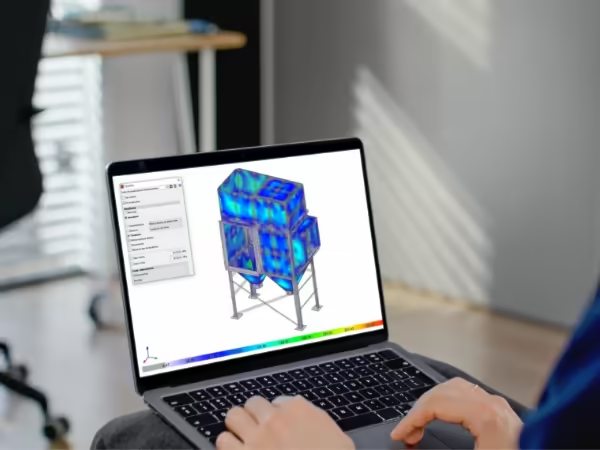
Defining the correct concept is only the beginning: the selected measures must then be integrated correctly into the actual installation. ADIX can develop the engineering required, working in coordination with the safety, project, maintenance and engineering teams involved. Depending on the scope, this can include equipment layouts, installation requirements, interfaces, duct modifications, instrumentation, control philosophy, interlocks and other engineering details, with clearly defined technical interfaces and responsibilities.
Explosion protection is not limited to new installations. Existing plants frequently require modifications because of process changes, new products, equipment upgrades, maintenance findings or updated safety requirements. We review how prevention and protection measures can be integrated into existing equipment, considering available space, accessibility, production constraints, existing controls and the requirements for inspection and maintenance.
When a standard solution is not enough
Some applications cannot be properly addressed with a standard protection product or a conventional installation arrangement. ADIX has its own explosion testing capabilities and extensive experience in the development and validation of explosion protection systems.
When required, our engineering team can develop a solution specifically for the application, perform the necessary explosion testing and validation, and work with certification bodies and accredited laboratories where independent certification is required. Rather than adapting the application to an existing product, we develop and validate a solution suited to the actual requirements.
The same testing capabilities, together with specialized and accredited laboratories, provide the technical data needed to design and validate the measures: confirming design assumptions, application limits and protection performance, as technical input for the whole project team.

Behind every risk analysis, audit or technical design are people who combine regulatory knowledge, practical experience and plant judgment. ADIX’s consulting team is made up of certified specialists with international experience in sectors such as animal feed, recycling, chemistry, biomass among others.
Its mission is to help you make safe, justified and applicable decisions, with technical criteria and a focus on detail.

He leads ADIX’s technical and strategic approach. With more than 20 years of experience in explosion protection, he brings global risk vision, sound regulatory criteria and the ability to design complex solutions.

Technical consultant specialized in explosion protection. It stands out for its practical application of ATEX, IECEx and NFPA regulations, and its precise and operational approach in industrial sectors.

Descripción
Talk to our engineering team
Send us the process information together with the relevant safety requirements and project criteria. We will review the application with you and discuss the available options.
