



Explosion Protection and Prevention
for Dust Collectors
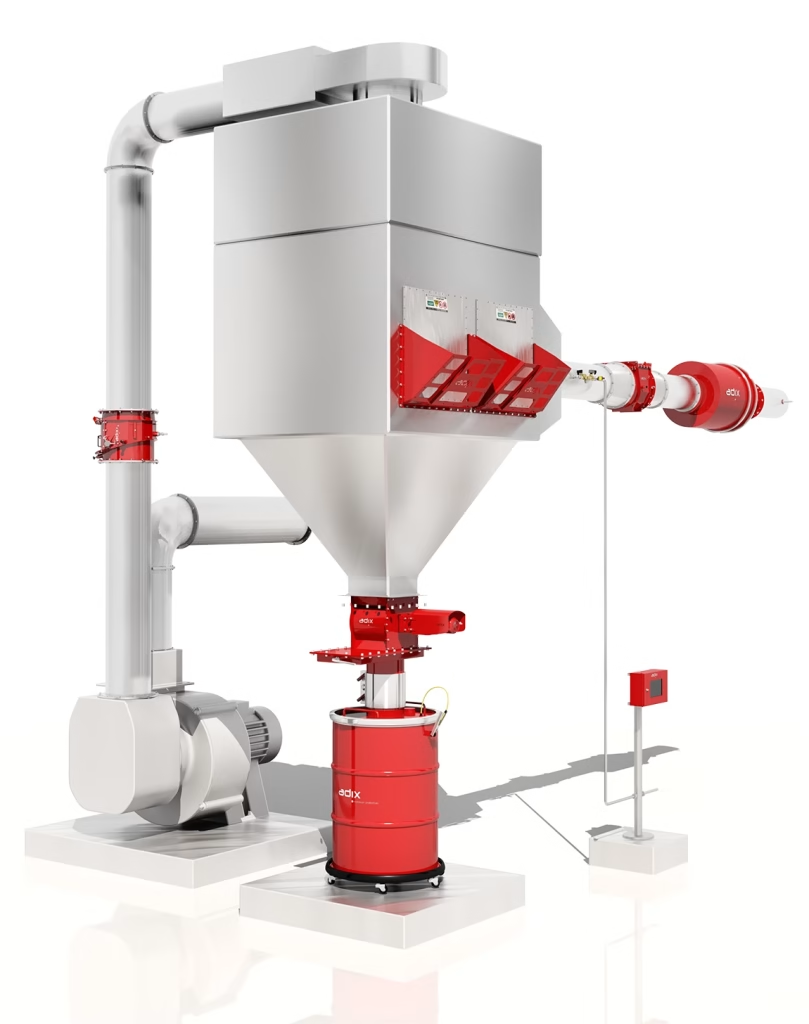
Dust collectors are essential for capturing and handling dust particles in industrial environments, but they also represent one of the greatest explosion hazards in a plant. A buildup of fine, dry dust combined with an ignition source can cause a deflagration inside the equipment if proper safety measures are not in place.
At Adix, we protect these systems by combining protection measures such as explosion venting or active suppression with explosion isolation to contain the explosion and prevent it from propagating, ensuring the safety of facilities and people.
Why can
a dust collector explode?
During normal operation, combustible dust can stay suspended or accumulate inside the collector, forming an explosive atmosphere. A single spark, mechanical friction, overheating or an electrostatic discharge can act as the ignition source that starts an explosion.
These explosions usually start inside the collector and quickly propagate through interconnected ducts to other equipment such as silos, cyclones or fans, causing major structural damage and critical risks to the process and personnel.


Main hazards
in dust collectors:
ADIX Solutions for Dust Collectors
We apply a combination of prevention, protection and isolation measures, tailored to each process and in accordance with the ATEX Directive (2014/34/EU) and international standards such as NFPA 68 and NFPA 69.
Explosion venting
Domed or flat explosion vent panels designed to relieve pressure safely.
Flameless venting
Ideal for indoor locations, it prevents flame and material ejection.
Active suppression
Pressure or infrared sensors trigger an extinguishing agent that puts out the deflagration within milliseconds.
Isolation
Explosion isolation flap valves or chemical barriers that prevent propagation to other equipment.


Not sure how to protect your dust collector?
We analyze your facility and help you apply the most effective solutions to prevent explosions and protect your dust collectors
