



Explosion Risk Assessment in Bucket Elevators
|
Date:
|
|
Reading Time: 5 minutos
(CLICK HERE TO DOWNLOAD THE E-BOOK VERSION (SPANISH))
Bucket elevators, used to convey bulk solids in industry, require a detailed explosion risk assessment
1. Introduction and standards
Bucket elevators are among the main equipment used to convey bulk solids in many food industry facilities: grain handling, breweries and feed mills, among others.
This equipment is one of the main explosion hazard areas in industries that handle combustible dust, mainly because it is highly prone to generating ignition sources of different kinds. That is why it is so important to carry out a proper explosion risk assessment in facilities that use bucket elevators, to reduce the likelihood of an explosion and, if one does occur, to minimize its consequences and prevent damage and injuries.
Several international standards are used to carry out a proper risk assessment. The most notable include:
- The European Technical Report CEN/TR 16829: Fire and explosion prevention and protection for bucket elevators, which deals exclusively with prevention and protection for bucket elevators, based on several studies.
- The German guideline VDI 2263, Part 8: Dust fires and dust explosions – Hazards, assessment, protective measures – Fire and explosion protection in elevators, 2008, a guide to bucket elevator prevention and protection under European Directives 2014/34/EU and 1999/92/EC, aimed at both manufacturers and end users.
- The US standard NFPA 61: Standard for the Prevention of Fires and Dust Explosions in Agricultural and Food Processing Facilities, which has a section devoted to prevention and protection measures for bucket elevators.

2. Explosion risk assessment
A proper explosion risk assessment should include at least the following:
- Hazardous area classification.
- Assessment of effective ignition sources.
- Likelihood of an explosion.
- Consequences of an explosion for the equipment and facilities.
2.1. Hazardous area classification in bucket elevators
The inside of the equipment is usually classified as Zone 20 because of its high operating speed and the high likelihood of continuously generating dust clouds within the explosible range, and also because dust layers can build up on the walls and be dispersed.
2.2. Effective ignition sources
1. Ignition sources generated by the elevator itself, such as:
- Hot surfaces caused by friction:
- between the belt and the casing due to belt misalignment.
- between the belt and the pulley due to slippage if belt tension is insufficient.
- between loose parts (buckets, pulley parts) and moving components.
- Bearing failures: bearings operate in dusty and often hot conditions that shorten bearing life, so a defective bearing that keeps running will generate heat.

- Mechanical sparks caused by:
- Buckets striking the casing (due to insufficient belt tension, a damaged belt or falling buckets) or the elevator discharge.
- Belt misalignment.
- Electrical equipment, due to:
- Equipment without proper protection, or damaged equipment.
- Improper grounding or lack of continuity.
- Electrostatic discharges caused by:
- Separation between the belt and the pulley.
- Buckets becoming charged by induction.
- Charging of any other component that is not properly grounded.
2. Ignition sources coming from interconnected equipment, for example hot particles or explosions in other equipment, as well as ignition sources from electrical equipment outside the elevator.
3. External ignition sources from maintenance, welding, cutting (hot work), smoking at the facility or deflagrations from other equipment. These ignition sources are prevented with administrative controls.
4. Ignition sources produced by the conveyed product itself, for example spontaneous combustion of dust deposits inside the elevator.
3. Recommended prevention and protection measures
Given the almost continuous presence of explosive atmospheres and the variety of ignition sources that can become effective, the likelihood of an explosion in a bucket elevator is high, and its consequences can be catastrophic for facilities and people.
Both explosion prevention and protection measures are therefore needed on this equipment, including those listed below.
3.1. Prevention measures
The following measures can be applied to prevent explosions:
- Preventing explosive atmospheres:
- Dust collection at the boot and head of the elevator.
- Regular housekeeping of the equipment.
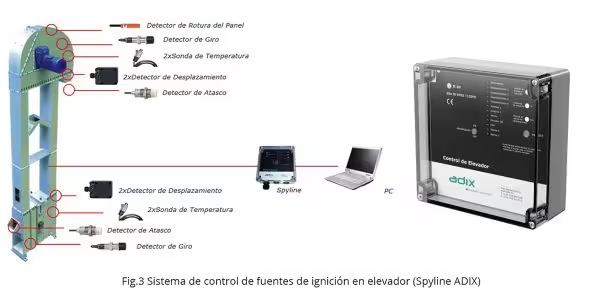
- Preventing ignition sources:
- Magnets or grates to keep foreign objects out.
- Belt misalignment sensors.
- Shaft speed monitoring at the boot pulley.
- Plug detection at the product discharge.
- Bearing temperature monitoring.
- Proper grounding and bonding, and an antistatic belt when the product’s minimum ignition energy is low (MIE < 10 mJ).
3.2. Protection measures
- Explosion vent panels installed on the boot, head and legs of the elevator, following the configuration given in recognized standards or guidelines (e.g., CEN/TR 16829).
- Flameless venting devices, if the equipment is located indoors.
- Chemical explosion suppression with a flame-extinguishing agent.

- Chemical or mechanical explosion isolation:
- Mechanical isolation with certified rotary valves (per ATEX Directive 2014/34/EU or NFPA 61) at the product inlet and outlet.
- Chemical isolation system (chemical barriers) at the product inlet and outlet.
- Mechanical isolation with an explosion isolation flap valve (passive isolation) in the dust collection duct.

Note: protection systems on bucket elevators must be implemented in accordance with a recognized standard or guideline (e.g., technical report CEN/TR 16829, VDI 2263 or NFPA 61).
