



Bucket Elevator Safety: Identify, Prevent and Protect

According to technical studies,nearly 50% of explosions in bulk solids handling facilities start in bucket elevators.
This article will help you:
- Identify the specific hazards associated with this equipment.
- Prevent hazardous atmospheres from forming and minimize the chances of ignition.
- Protect your facilities with certified solutions that comply with ATEX regulations and international technical standards.
Bucket elevators are essential for conveying bulk solids vertically in industries such as animal feed, agri-food, chemical and sugar, among others. Their enclosed design, fine dust buildup and many moving mechanical parts favor the formation of explosive atmospheres and ignition sources, making the bucket elevator a critical point for industrial safety.
Why are bucket elevators a critical explosion hazard?
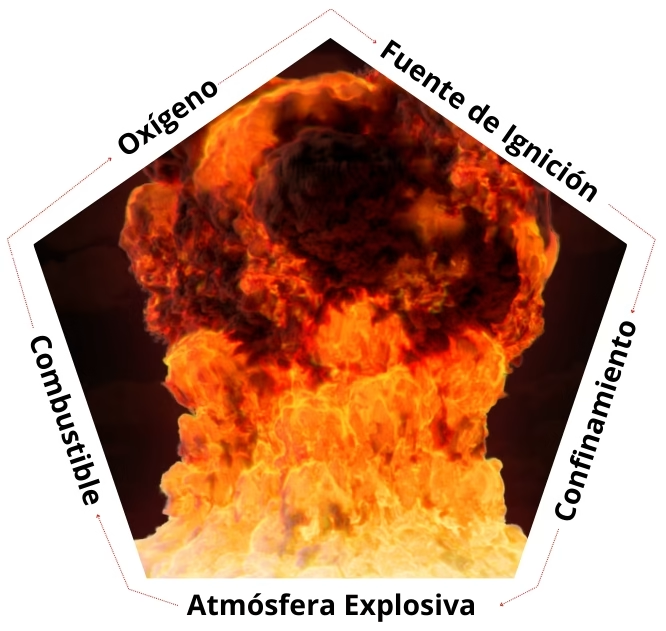
The combination of three key factors makes this equipment one of the most vulnerable points for dust explosions:
- Combustible dust:Fine, dry materials conveyed by the elevator, such as feed, starches or chemicals, have high explosive potential. Even a small amount of accumulated dust can create a hazardous mixture with air
- Explosive atmospheres:Dust buildup or suspended dust, combined with internal turbulence and a lack of effective dust collection, can create explosive atmospheres inside the equipment.
- Internal ignition sources:The mechanical operation of the equipment can generate heat, friction and sparks. If these sources are not eliminated or controlled, the risk of ignition rises considerably. Poor maintenance makes these risks worse.
The most common critical points where ignition sources can appear include:
- Belt rubbing or misalignment, generating heat and glowing particles.
- Bearing overheating, due to wear or lack of maintenance.
- Plugging, foreign objects or slippageof the belt on the pulleys.
- Belt breakagewith metal buckets, which can generate sparks.
- Electrostatic discharges between components that are not properly grounded.
Combined with an explosive atmosphere, these ignition sources can trigger an explosion inside the elevator, with a risk of propagation to other connected equipment.
Explosion Prevention and Protection Measures
Once the causes that make the bucket elevator a critical hazard have been identified, it is essential to address the elements of that risk: combustible dust, the explosive atmosphere and ignition sources. When the absence of all three cannot be guaranteed, facilities must add measures to anticipate, control and mitigate any potential explosion scenario.
Prevention Measures
Prevention is the first line of defense against dust explosion risk in bucket elevators. Addressing the factors that favor explosive atmospheres and/or potential ignition sources significantly reduces the likelihood of a deflagration during operation.
The most common measures to prevent explosive atmospheres::
- Dust collection at the boot and head of the elevator.
- Regular housekeeping of the equipment.
Measures to address potential ignition sources:
- Proper grounding and bonding, and an antistatic belt when the product’s minimum ignition energy is low (MIE < 10 mJ).
- Magnets or grates to keep foreign objects out.
- Ignition source monitoring: bearing temperature, belt misalignment, speed and plugging.

In addition, a rigorous preventive maintenance program combined with continuous industrial housekeeping is essential to keep the risk under control. These practices prevent key components from deteriorating and ensure that all prevention systems work properly.
Protection Measures
When the risk cannot be eliminated completely, protection measures are applied. These solutions are designed to limit the destructive effects of an explosion, preventing its propagation and reducing damage and injuries.
The most common protection measures for bucket elevators include:
- Explosion venting:Explosion vent panels that release pressure and flames to safe areas.
- Flameless venting:Contains the flames in a mesh enclosure, letting combustion gases escape without emitting flame.
- Explosion suppression:Extinguishing agents suppress the explosion in its initial stage, preventing the pressure rise.
- Explosion isolation:flap (backflow) valves, rotary valves, screw conveyors or chemical barriers that prevent propagation to adjacent equipment.
The choice of protection measures must be based on a rigorous technical analysis tailored to the specific operating conditions of each elevator. The applicable standards recommend combining protection and isolation systems, selected according to the type of product, the equipment design and its location in the plant.
One of the most widely used solutions is explosion venting, with panels or doors installed at strategic points (usually the head and boot of the elevator). These devices release the pressure and flame generated during a deflagration in a controlled way, preventing structural damage. However, when the elevator is located indoors, conventional venting can create a new hazard, as discharging the explosion into an enclosed space can have severe consequences.
In these cases, flameless venting systems are preferable: they use a metal mesh to cool and contain the flame, allowing safe indoor installation without spreading fire to the surroundings.
When greater protection is needed, or the system design does not allow venting, explosion suppression is the most effective option. These systems detect the deflagration within milliseconds and trigger pressurized containers of extinguishing agent (such as sodium bicarbonate), suppressing the explosion before it fully develops.
Suppression can also play a critical isolation role when installed in the elevator’s inlet or outlet ducts. It then acts as a chemical barrier that stops the flame from propagating to other interconnected equipment such as silos or cyclones. This is especially important in the elevator legs, where a pressure wave could build up and cause severe damage.
Most common combinations by process type:
- Venting + mechanical or chemical isolation, for equipment located outdoors.
- Suppression + chemical isolation, when the elevator is indoors or handles products with a low MIE.
- Flameless venting + chemical barriers, in critical processes where no flame or glowing particles may be released.

Applicable Standards and Certifications
- ATEX Directive 2014/34/EU
- UNE-CEN/TR 16829:2016
- NFPA 61, 68 and 69
- UNE-EN ISO 80079-36:2017
Case Study: Explosion Protection Equipment on Bucket Elevators
As part of a safety upgrade project at a sugar manufacturing facility, two indoor bucket elevators that convey raw sugar vertically were fully protected. Both double-leg elevators posed a significant risk due to dust buildup and the lack of active explosion protection systems.
Initial Assessment
Following anexplosion risk assessment (ATEX), advanced explosion protection systems were found to be necessary to reduce mechanical and explosion risks, given the combustible nature of sugar dust and the conditions favoring ignition (heat from friction, dust buildup, continuous mechanical movement).
The technical assessmentidentified the following hazards:
- Zone 20 classification inside, with housekeeping procedures, local dust collection and proper grounding in place.
- High explosion risk due to dust buildup inside the elevator.
- No temperature monitoring on bearings and critical areas.
- Exposed moving parts without proper guarding.
- No explosion suppression or isolation systems.
Under Directive 1999/92/EC, when preventive measures are not enough to eliminate the risk, specific protection systems are mandatory.
Solutions implemented
A combined suppression and chemical isolation strategy was chosen, designed to act within milliseconds of an incipient explosion and prevent its propagation through the system.
- Additional mechanical guarding:
- Hinged metal covers and perimeter guards with safety interlocks.
- Automatic shutdown if the guards are open.
- Continuous monitoring and control:
- Bearing temperature probes (alarm at 167 °F / 75 °C).
- Belt misalignment and speed sensors.
- Full integration into the plant SCADA system.
- Explosion suppression system:
- 13.2 lb (6 kg) suppression and isolation containers at the head and boot of the elevator.
- Pressure and optical detectors certified for Zone 20.
- Centralized line controller.
- Supplementary isolation system:
- 13.2 lb (6 kg) suppression and isolation containers on the elevator legs.
- Chemical barriers on the dust collection, discharge and inlet ducts.

Results
After the system was implemented,there were tangible improvements in safety and operation:
- Elimination of entrapment risks and exposure to moving parts.
- Over 80% reduction in dust buildup in critical areas of the elevator.
- High fault traceability thanks to real-time monitoring.
- Very fast response to critical events (detection + suppression < 20 ms).
- Elimination of the risk of propagation to silos and logistics areas.
- Verified ATEX compliance.
- Launch of a predictive maintenance plan based on real operating data
