



Explosion Risk Assessment in Dust Collectors (Baghouses)
|
Date:
|
|
Reading Time: 5 minutos
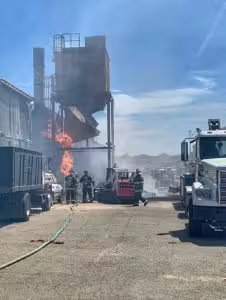
Dust collectors are one of the most critical explosion hazard areas in facilities that handle combustible dust
Dust collection systems are among the main installations in industries that handle powders, used mainly to control dust emissions and reduce pollution. Baghouse dust collectors are the main component of dust collection and solid-gas separation systems, and they are one of the main explosion hazards in industries that handle combustible dust.
A proper risk assessment of dust collection systems, and of baghouses in particular, should be one of the main goals when establishing an effective strategy against explosion risk in a facility.
To properly assess the explosion risk in this equipment, we can rely on some of the most widely used and recognized international standards, including:
- The German guideline VDI 2263, Part 6: “Dust fires and dust explosions – Hazards, assessment, protective measures – Dust fires and explosion protection in dust extracting installations,” 2017.
- The guide to Directive 2014/34/EU, in the section on specific cases, particularly “§ 243 Filter units and vented silo bins.”
- The US standards NFPA 61: Standard for the Prevention of Fires and Dust Explosions in Agricultural and Food Processing Facilities, and NFPA 654: Standard for the Prevention of Fire and Dust Explosions from the Manufacturing, Processing, and Handling of Combustible Particulate Solids.
2. Explosion risk assessment
A proper explosion risk assessment should include at least the following:
- Hazardous area classification.
- Assessment of effective ignition sources.
- Likelihood of an explosion.
- Consequences of an explosion for the equipment and facilities.
2.1. Hazardous area classification in dust collectors (baghouses)

Notes:
- Due to cleaning cycles or possible dust layer buildup inside the collector (including dust layers on the bags). MEC: minimum explosible concentration (g/m3). Examples: sugar (30 g/m3); starch (60 g/m3); wood (30 g/m3). Data from the GESTIS-DUST-EX database: https://staubex.ifa.dguv.de/explosuche.aspx?lang=e
- An automatic cleaning system is any system that uses compressed air, whether timer-based or differential-pressure-based, or any system that uses vibration or mechanical means or requires activation by an external push button. Manual cleaning involves shutting down and opening the equipment, and removing and cleaning the filter media.
2.2. Effective ignition sources
- Mechanical sparks from other equipment, when the baghouse collects dust from mechanical equipment prone to failure (mills, bucket elevators, conveyors, etc.).
- Hot surfaces caused by friction in the collector’s mechanical discharge equipment (rotary valve, screw conveyor) or in woodworking process equipment (saws, dryers, etc.).
- Electrical equipment, due to:
- Equipment without proper protection, or damaged equipment.
- Improper grounding or lack of continuity.
- Electrostatic discharges, caused by static buildup from friction between the collected product and the internal components of the collector, and by lack of equipotential bonding.
- Ignition sources coming from interconnected equipment, for example hot particles, fires or explosions in other equipment.
- External ignition sources from maintenance, welding, cutting (hot work) or smoking at the facility. These ignition sources are prevented with administrative controls.
- Ignition sources produced by the conveyed product itself, for example spontaneous combustion of dust deposits inside the collector.

3. Recommended prevention and protection measures
Given the almost continuous presence of explosive atmospheres and the variety of ignition sources that can become effective, the likelihood of an explosion in a baghouse is high, and its consequences can be catastrophic for facilities and people.

3.1. Prevention measures
- Preventing explosive atmospheres:
- Reduce cleaning cycles.
- Regular housekeeping.
- Preventing ignition sources:
- Install a spark detection and extinguishing system in the inlet duct to prevent sparks or hot particles from other equipment from entering (see Figure 4).
- Install a fire detection system using CO, infrared or temperature detection.
- Proper grounding and bonding of the bag supports, and antistatic filter bags.

3.2. Protection measures
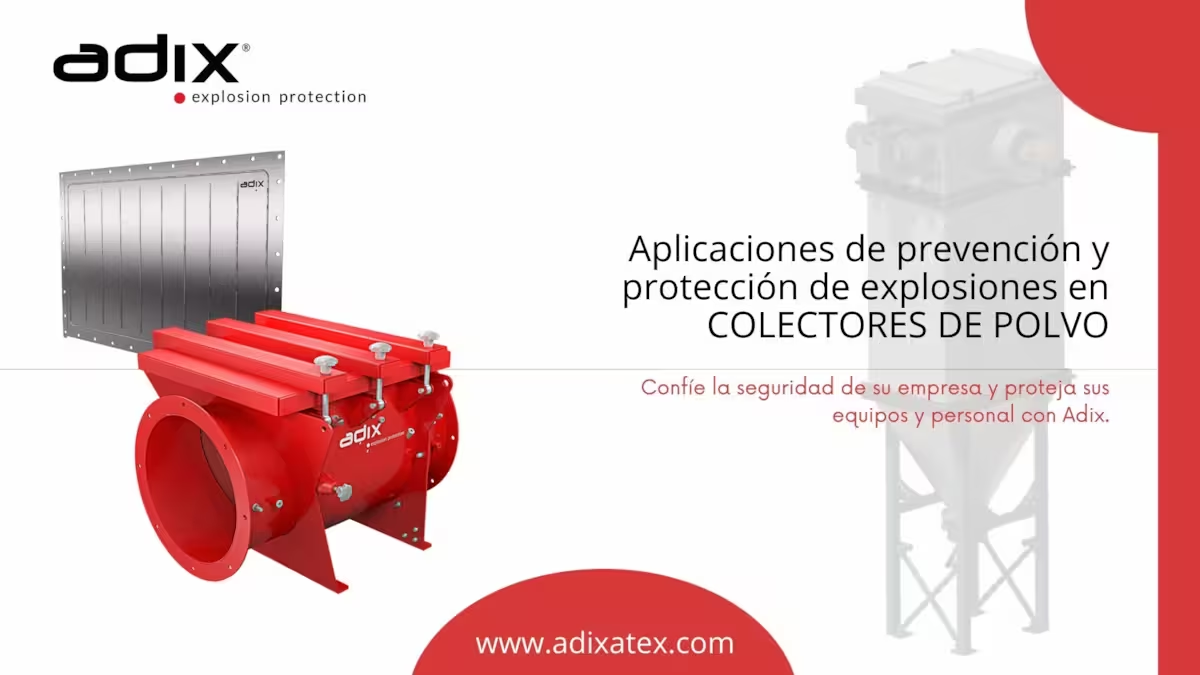
- Explosion vent panels certified to ATEX Directive 2014/34/EU, with the vent area calculated per a recognized standard (EN 14491:2012, “Dust explosion venting protective systems,” or NFPA 68, “Standard on Explosion Protection by Deflagration Venting”).
- Flameless venting, if the equipment is located indoors.
- Chemical explosion suppression, using a system certified to ATEX Directive 2014/34/EU.
- Explosion isolation:
- Mechanical isolation with an explosion isolation flap valve (certified as a protective system to ATEX Directive 2014/34/EU or approved by an authorized body per NFPA 69) installed in the dust collection duct.
- Chemical isolation system (chemical barriers) installed in the dust collection duct.
- Rotary valves certified as isolation systems (to ATEX Directive 2014/34/EU or NFPA 69) installed at the product discharge.

